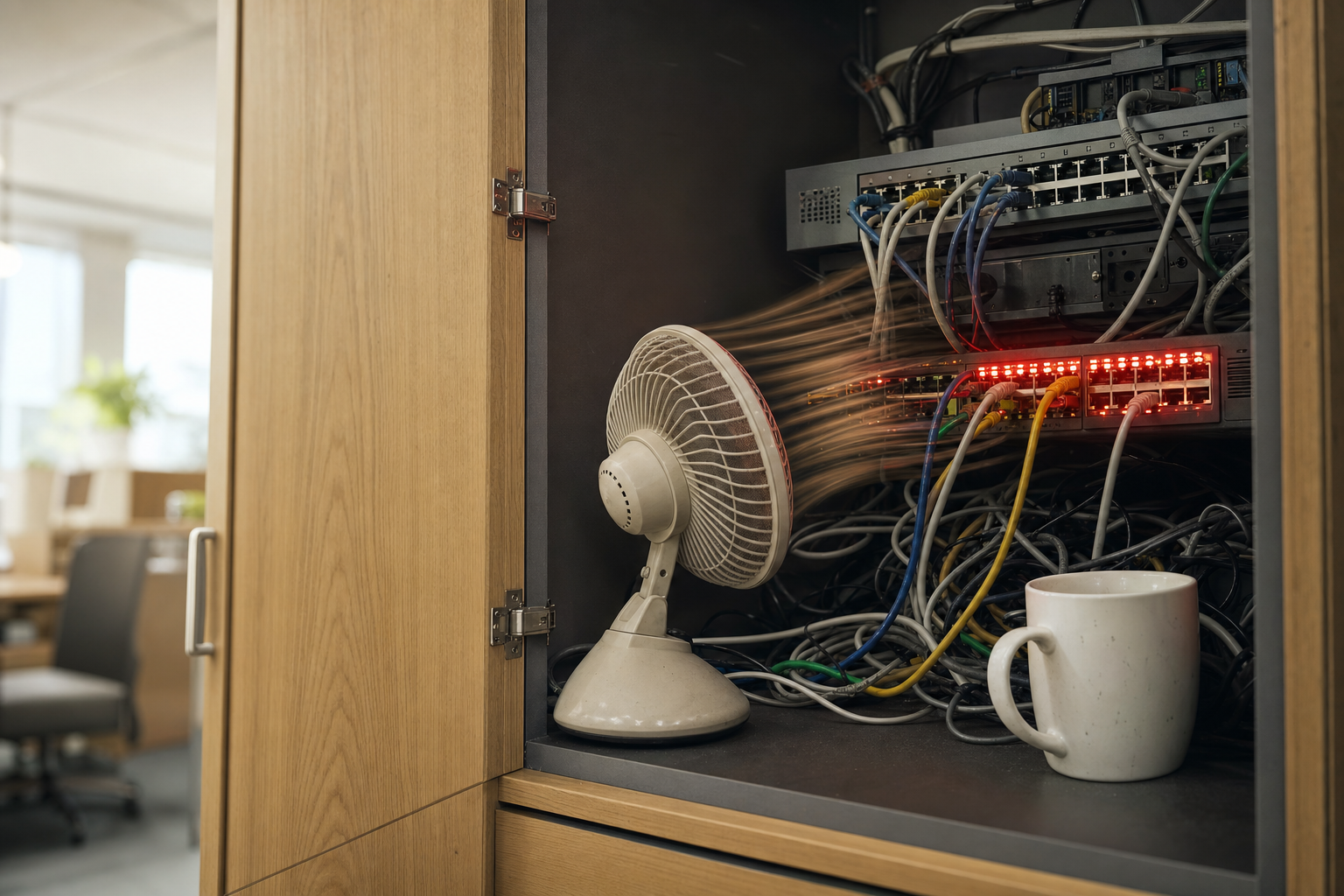
There is a scene in every long British summer — and I mean every one, going back to at least 1976 — where somebody opens a door they haven't opened since Christmas and is surprised by what they find. In 1995 it was my Uncle Gerald's shed on Beeston Road, and what he found was a lawnmower, two deckchairs with no canvas left, and a wasp nest the approximate size and temperament of a football. He closed the door. He did not open it again until October. The wasps, for their part, had organised themselves into something that operated like a small, angry republic.
I think about that shed every time I walk past a comms cupboard in a client's office in July. Same door, same instinct to leave it alone, same quiet certainty that something in there has been getting on with its own agenda while nobody was paying attention. The difference, of course, is that the wasp republic did not run Gerald's phone system, his card reader, or his access to the cloud-based software that invoiced his customers. His did not go down in the heat. Yours might.
Which brings me, against all reasonable odds, to the inside of a cupboard in your building. The UK is in its third heatwave of 2026. Britain has now logged a record eight days above 34°C in a single year, beating the previous record shared by 1976 and 2020, and 2026 became the first year in the UK record to hit 35°C or higher in May, June and July. The Met Office expects the current hot spell to hold through much of the coming week and peak around 35–36°C in southern and eastern England by about Thursday–Friday, 16–17 July. Finnwood's position on this is blunt and unfashionably practical: check your comms cupboard today. A £40 thermometer and a spare fan are cheaper than an afternoon of downtime, and an afternoon of downtime is considerably cheaper than what happens if you do nothing and the thing goes dark.
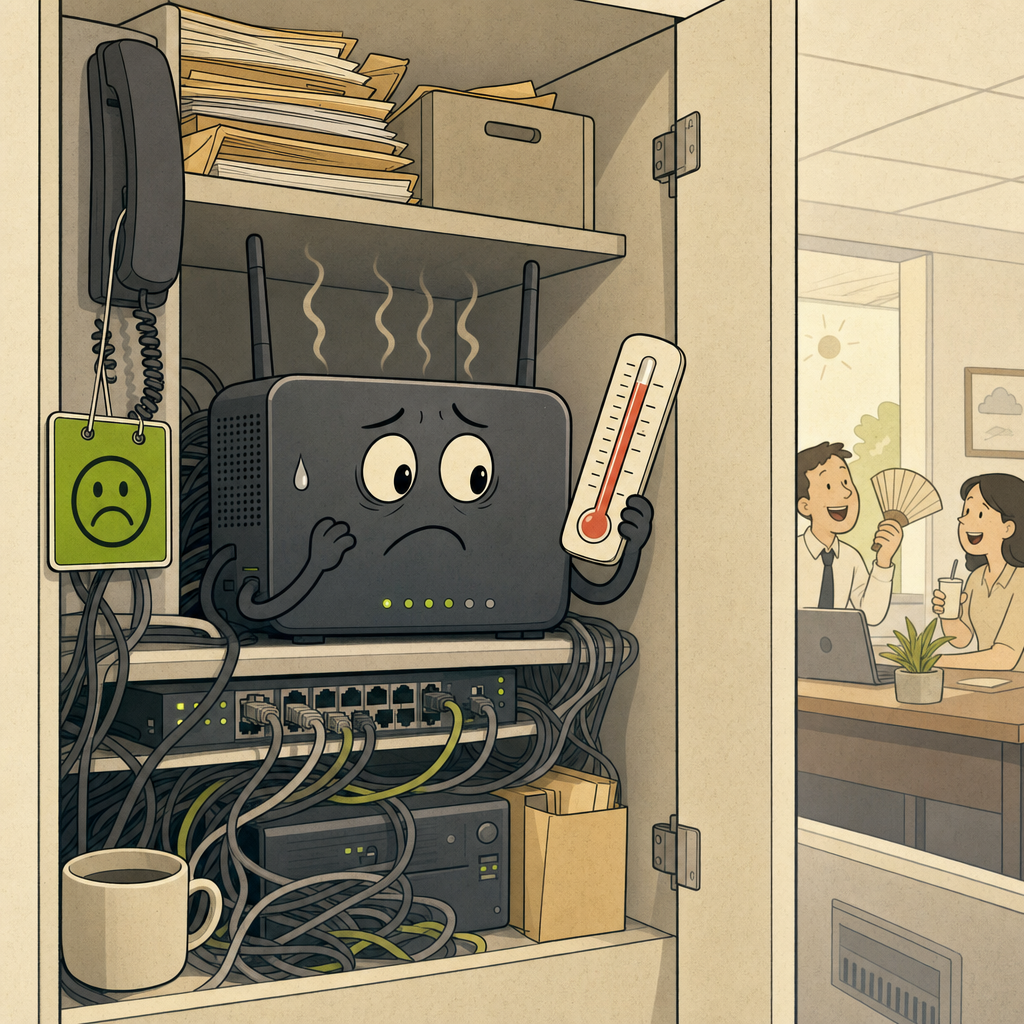
We know what happens because we have watched it happen — repeatedly, and at increasingly embarrassing scale. In July 2022, when London hit 40°C, Guy's and St Thomas' NHS Foundation Trust spent two months getting back on its feet after a heatwave fried its datacentre — two linked datacentres failed simultaneously as temperatures soared. The failure resulted in most of the clinical IT systems at the Trust's hospitals and related community services becoming unavailable, forcing staff to employ a paper-based system to keep records. The Trust incurred £1.4 million in out-of-plan spending on technology services to respond to the incident. And the truly magnificent detail, the one that should be laminated and stuck to every comms cupboard door in the land: concerns about the cooling system setup in one of the datacentres had been raised in 2018 and never fully acted on. Four years of knowing. One very hot Tuesday. £1.4 million and two months of chaos.
Fast forward to this summer. The University of Cambridge was forced to abruptly shut down its multi-million-pound AI supercomputer, Dawn, after an intense UK heatwave pushed facility temperatures beyond operational safety limits. The supercomputer was one of several services that suffered an outage on 27 June due to excessive temperatures, and it is believed the incident was caused by a failure with the cooling system at the West Cambridge data centre where Dawn is housed. This is a machine that supports oncology, Parkinson's disease molecular screening, and climate modelling. All of it paused because the building got warm. Now: the University of Cambridge is not a Leeds accountancy firm with a Netgear switch balanced on top of a filing cabinet. If it can happen there, the question of what happens in your back office is not a rhetorical one — it is a Tuesday afternoon waiting to occur.
The mechanism is straightforward and merciless. The weak points of the internet connection we all take for granted are the power grid, cooling systems, and local telecom equipment. Extreme heat increases electricity demand for air conditioning, reduces grid efficiency, and increases the risk of outages — all of which can quickly cascade into failures across broadband, mobile, and data centres. If your network equipment is sitting in an area that becomes unusually hot during summer, a small room or cupboard that is harmless in winter can become a very different environment during a heatwave. A single overheated switch does not politely take itself offline and send you an apologetic email. It takes your phones with it. Then your card payments. Then your VPN, your cloud access, your ability to send an invoice. The whole lot, in the time it takes to make a brew that nobody can enjoy because the kettle is on the same circuit.
The combination of extreme daytime heat and very warm nights is especially significant, as it increases the impacts on infrastructure, health and wellbeing. A major short-lived heatwave like this won't cause major national outages — only more localised and limited disruptions. "Localised and limited" is the phrase that should concentrate the mind. National outages make the news. Localised ones just make your afternoon a misery and your customers impatient. Nobody writes a headline about a routing switch in a cupboard on an industrial estate in Morley going down at half past two on a Thursday. It just happens, quietly, and you deal with it expensively.
The fix is not glamorous, which is probably why it doesn't get done. Check server cupboards, comms rooms and areas with routers, switches or phone equipment. Keep them clear of boxes and paperwork, which can block airflow and trap heat. If you use air conditioning or fans in these spaces, check they are working safely. That is the whole job, more or less. A thermometer — the kind you'd pay £40 for at a DIY shop — tells you whether the ambient temperature in that cupboard has crept past 30°C, which is roughly where Cambridge's cooling systems failed to mitigate the thermal output of the Dawn supercomputer. A desk fan pointed at the cabinet costs less than the first hour of downtime. Neither requires a specialist. Both require someone to open the door.
Uncle Gerald's wasp republic, for what it's worth, resolved itself peacefully. He opened the shed again in October, found an empty nest and two deckchairs with no canvas, and replaced neither. The wasps had taken nothing with them. Your overheated switch, by contrast, will take your phones, your payments, and your afternoon — and unlike Gerald, you won't get to keep the deckchairs. If you'd like someone to open the cupboard with you, point a thermometer at what's in it, and tell you honestly what needs doing before this week's peak hits, give Finnwood a ring. We have looked inside a great many cupboards. We are not frightened by what we find in them.